Mini Cleaver

Kevin Zito

KNIFE MAKER
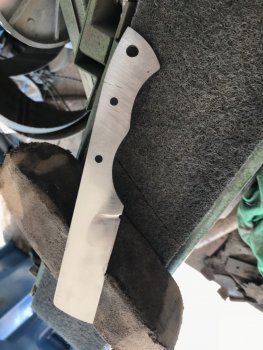
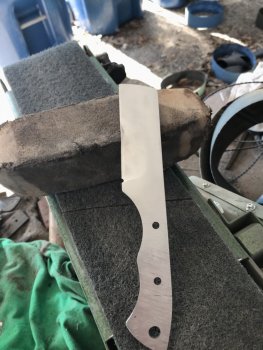
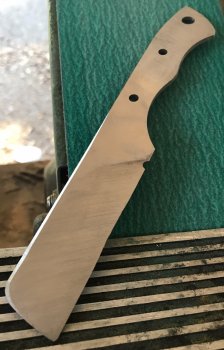
I always thought these were really cool looking so I decided to make one. Please note that this is very rough; I still have lots of grinding to do. Anyway, can anyone tell me what these are really used for???
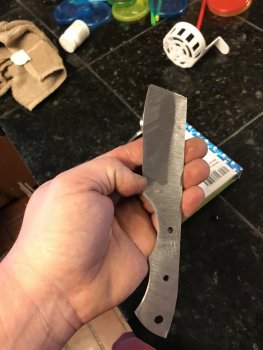

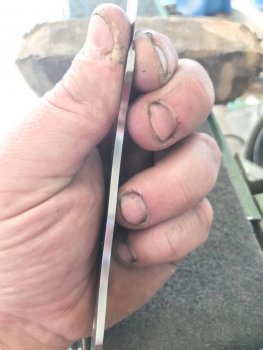
867D1701-BFBC-475C-B725-EC016C694AB0.jpeg
 
Just kinda wanted to get some of my other projects out before the seventh you know. L&@3o!!! Pahahahahh totes jk
 
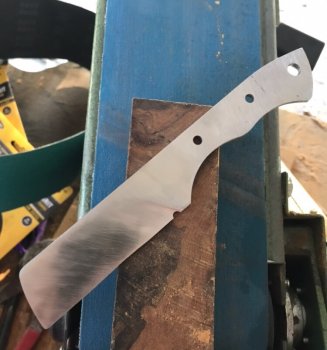
Lol OP I didn’t see your post before I posted mine ... nice cleavers! I really like them too. So I just figured might as well have one and did it
 
I just did a pattern for a kitchen cleaver the other day but have to order in some 1/4 in steel (probably 1075) but mine wil be 12 inches overall so a bit more than the mini clleaver although I did do one early one for splitting rabbitsduring ceaning of them that is just 9 inches overall but have found it to be a bit acking in actua use so will do a more practical version to go with my kitchen knife set.
wOuyNJql.jpg
 
I
I just did a pattern for a kitchen cleaver the other day but have to order in some 1/4 in steel (probably 1075) but mine wil be 12 inches overall so a bit more than the mini clleaver although I did do one early one for splitting rabbitsduring ceaning of them that is just 9 inches overall but have found it to be a bit acking in actua use so will do a more practical version to go with my kitchen knife set.
wOuyNJql.jpg
i was thinking maybe for rabbits squirrels and frogs. I’m definitely gonna try it out. Great looking cleavers by the way!
 
I just put in an order for some 12C27 stainless which will make the cleaver more suitable for kitchen use in conjunction with the knife set.
 
Kevin, you asked what they are for: Everything! (at least everything that doesn't require poking holes.)

In sailing, this kind of knife is called a "rigging knife." Pointy knives are frowned upon when working the deck on sailboats. It's a lot harder to slip and stab somebody or slash sails with a rigging knife. In the old days, when a hand got a new knife he had to report to the Bosun to have the tip ground off, so rigging knives go back a long way.

If you ask me, the wharncliffe/sheepsfoot/cleaver blade shape is perfect for 99.999% of everyday utility tasks.
 
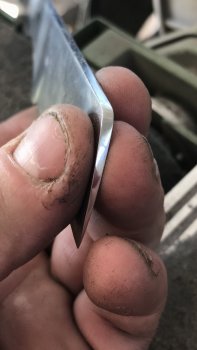
Thanks, John! I figured there had to be a fairly well-defined use. I think they’re awesome looking. So I’m trying to give this mini cleaver some flava. But I have the hardest time trying to get the plunge line / not breaking the spine right. Is this easier with a real grinder?? Also ... lol please help me with this process in general. I have to improve here as there are designs that I want to do but can’t because of my inability.07B493F2-6527-4D65-BABC-8F196B31AB27.jpeg
 
You're doing great, especially with the grinder you have. Angling the blade is about all you can do.

On a 2x72 this is an easy process. There are two ways to terminate the plunge at the top- a straight line, or a little swoopy curve.

If you want a full height grind with the little swoopy curve at the top of the plunge, you track the belt off the side of the platen, let's say 1/4 inch. That way the belt has no support under that last 1/4 inch where it hangs off the side of the platen, and thus where it contacts your plunge line. Because of this your plunge line will be defined most of the way up, but at the top where the belt flexes away from the blade it doesn't cut as deep. The belt "falls off" as a smooth curve as stiffness falls off. How far you run the belt off the side of the platen determines the length/arc of your swoop.

Then when you make passes on the other side of the blade, you track the belt 1/4 inch off that side. Repeat this process each time you switch sides on the knife.

The trick is then learning to track the belt off the side evenly when you do each side or else your little swoop at the top won't be the same on both sides. This is where a file guide is worth its weight in gold because you can sneak that file guide right up to the edge of the belt and you know you're creating the same angle on each side with no fear of the belt jumping out of the plunge and eating your plunge line up.

For straight terminations, you do exactly what you do on your current grinder and you mark a line along the top of the blade where you want to terminate the bevel, and simply stop grinding when you get to that point to make sure you don't break through the spine with the plunge. Layout fluid and a caliper works great for this.

By angling the blade, as you did above, you can draw your plunge lines out but you still have to decide how they terminate, straight or swoopy.

***With the grinder you have, hand sanding will be your best friend. You can do a whole lot to the terminations on your plunges based on how you hand sand. Stop your plunge about an 1/8 inch below the spine. If you want to soften a hard stop into a swoop, hand sand with a piece of leather between your sanding stick and the sandpaper. Sand the top of the plunge and the spine area until the plunge fades at that corner. Don't overdo it because you don't want a rounded out divot there. You're only looking to soften the corner and blend it some.
 
Wow thanks John!! That is exactly the info I was looking for! Thanks for taking the time I real appreciate it! I tried to do similar things with my grinder, but it just don’t want to stay still. Grrr.
 
You can make one if you wish. Lots of how to's out there if you want to look.

Otherwise, I have a Bruce Bump file guide. Love it.

There is another knife maker that makes them, several makers on KD own one. I just cannot remember his name off the top of my head. Some one else should post his name up. He makes a nice one also.
 
Back
Top