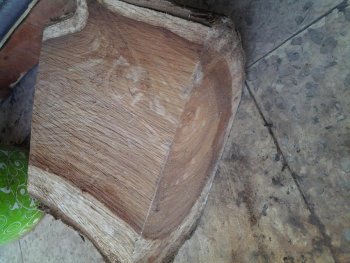
rough cut wood, what now?

SHOKR

Well-Known Member
Hey guys
The amount of titles for this thread that i deleted just because they felt inappropriate was not funny lol

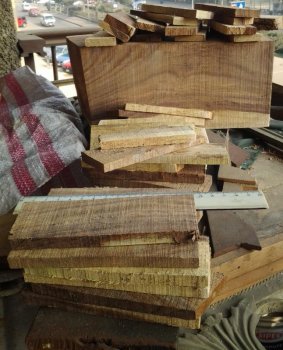
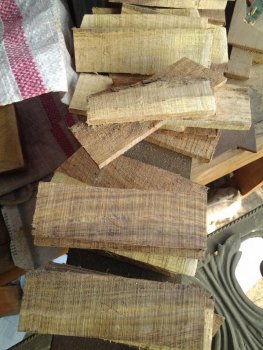
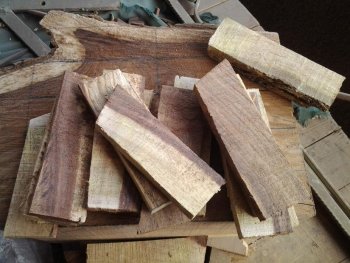
Anyway, i bought a block of wood few months ago, had trouble finding a shop to cut it for me, but discovered one yesterday.
According to the seller this is 'dead', when i asked he said it wont change shape anymore
Also he told me name in arabic, quick online search and its indian rosewood!

i quickly numbered them when being cut.

where to go from here? Just sand and use or are there other things to do/consider, be it for use, storage, cleaning, anything really i have no experience with this for handle material (except wearing respirator of course)

I will clean a couple and post pics after :)


Thanks

20121229_103249.jpg20121229_103446.jpg20121229_104244.jpgIMG_20121229_150243.jpg
 

Attachments

  • IMG_20121009_120158.jpg
    IMG_20121009_120158.jpg
    96.8 KB · Views: 32
Last edited:
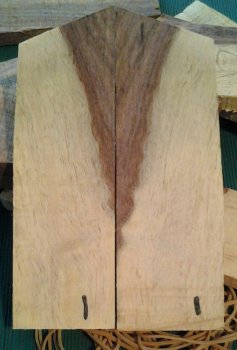
After inspection, the guy cut the block terribley, when splitting the scales he had wavey motion and one side is thicker than the other.
For those who have experience with that, how realistic is the standard of cutting and splitting of scales?
I still have most of the block intact, thinking of going back, maybe paying the guy extra to take care while splitting, but want to make sure of the possible standards and how to handle wood afterwards

Thanks
 
the scales don't have to be the same size....just flat on one side each to attach to the knife tang. If they aren't even, you just have little more waste on one than the other.
 
Like Boss dog said, Clead them up on the inside flat to about 220G and then clamp them down to drill your pin holes etc..
Then it's time to take out that platen and even the thickness and sculpt the outsides of scales on a stiff OA belt.

Also Rosewood can be nasty and I can't use it anymore because I started breaking out in rashes etc..
So wear your mask.

Laurence

www.rhinoknives.com
 
Shokr,
I make my own scales from rough pieces. I split the wood with wedges until there are areas thin enough to cut on my tablesaw, 3" or 75mm. Then I make a few cuts with the table saw and see what patterns are there. I will take pictures the next time and post as a tutorial.
Once you have two pieces you are happy with and have arranged them, as Laurence said, sand to 220 and make sure the part that will touch the blade is smooth and level. When the glue is set, I usually let the pieces dry at least overnight, then start shaping. I use my bandsaw rough in the shape, then the belt sander. I use a dremel or die grinder with a burr bit to shape also. Once I am happy with shape and feel, hand sand to 180 or 240 until smooth and free of any marks. Wipe the scales off with dry rag, then wipe them off with rag and rubbing alcohol. the rubbing alcohol gives the wood a wet look and you can sometimes see scratches you could not see when dry. the alcohol will also remove any oil stains that might show up in you finish.
I finish my knives with either rubbing oils or water based polyurethane. At least 5 coats, sanding between coats.
the old sailor
 
thanks a lot scott

i actually thought its just sand and an oil layer in the end!!
 
Shokr,
depends on the oil. if it is plain mineral oil, then one coat. If it is a rubbing oil; Watco, Forby's, Danish Oil Finish or similar, the more coats the deeper the finish. something to experiment with. as the pores and grain of the wood are filled with finish, it changes the way the wood reflects light and can change the appearance of the handles. I progressive sand between coats. 240 grit after first coat, 320 after second, 600, then 1000 or 0000 steel wool before final coat.
the old sailor
 
After inspection, the guy cut the block terribley, when splitting the scales he had wavey motion and one side is thicker than the other.
For those who have experience with that, how realistic is the standard of cutting and splitting of scales?
I still have most of the block intact, thinking of going back, maybe paying the guy extra to take care while splitting, but want to make sure of the possible standards and how to handle wood afterwards

Thanks

Shork, I split quite a few blocks and scales on a regular basis and have found it to be rather satisfying. The trick is to tune your band saw by making sure that the blade and table are as close to a perfect 90* as possible and that you have corrected for blade drift. Also, you need a good sharp blade with the proper amount of teeth for what you are doing. I run a 106" carbide 3TPI with alternating rake and have found this to work best for me. I've tried tested over 12 different blades and spent quite a few bucks doing so to find that the weld of the blade is as important as the manufacturer. Case in point, I paid over 200.00 for a Laguna carbide blade that had an average weld, it held up for a few month and finally snapped at the weld while cutting some Cocobolo. Before it snapped, the blade drift was uncontrollable and changed from day to day. Luckily woodcraft replaced the blade and I was able to sell it and fund the purchase of a better one. After doing some research I found a company that had a comparable blade and an uncanny reputation for immaculate welds. So far this blade cuts every bit as good as the Laguna at one third the cost and after adjusting for the blade drift once, it has been superb. I've been able to cut 1/16" thick pieces up to 11 inches in height with very uniform results. Anyhow, I'm babbling.... hope this helps.
 
thanks scott!

will be 'fun' finding the local equivalents for these lol

You must have some craftsman that repair Antiques and make furniture for the rich folks there?
Stop by and ask them what kind of oil the use and can get locally?

Mineral oil is the kind for ingestion to make you poop! Should be available at any Drug store or Pharmacy? Your local Walmart type store?

Laurence

www.rhinoknives.com
 
thanks Laurence

i have a friend who has a wood workshop, will ask him, i hope he answers within this year :p

ppl take oil for that?! hmmm interesting i guess that can be found at 'etaraa' a place for herbs, natural medication and bunch of seriously strange things!!
 
Mike, thanks a lot for the info

and thats awesome cutting capabilities!!

i doubt i can control so many things when i tell the guy to cut scales for me, maybe tip him lol, but i have been thinking about getting my own bandsaw and those tips helped

thanks again :)
 
Mike, thanks a lot for the info

and thats awesome cutting capabilities!!

i doubt i can control so many things when i tell the guy to cut scales for me, maybe tip him lol, but i have been thinking about getting my own bandsaw and those tips helped

thanks again :)

You won't regret getting your own bandsaw, I still haven't. :) If you do the math, in a year or so, it will pay for itself. Sooner if you side work. For resawing logs you will need to build a sled to keep it from moving on you and damaging the blade. You may want to suggest it to your wood guy as it also increases productivity and decreases waste.

My set up looks like this one:
6365d1231203280-resaw-sled-ash-log-002.jpg
 
Nice set up!!!
He has one but really small, at least that the one i saw, they have different bandsaws, when i was leaving they werespliting a long piece of wood, two guys held it and walked to and away from the saw lol

Problem with buying one so far, all i found was fixed speed. And i will want to cut synthetics, hardwoods, and if possible steel too!

Thanks for sharing Mike
 
You're going to have to find an older model that is geared. I've seen quite a few pre 1980 band saws that had step down gears to allow for metal, wood and plastic without putting stress on the motor, wheels or bearings. I hate to say it but some times it is best to have a dedicated band saw for wood and one for synthetic and metal.
 
You won't regret getting your own bandsaw, I still haven't. :) If you do the math, in a year or so, it will pay for itself. Sooner if you side work. For resawing logs you will need to build a sled to keep it from moving on you and damaging the blade. You may want to suggest it to your wood guy as it also increases productivity and decreases waste.

My set up looks like this one:


6365d1231203280-resaw-sled-ash-log-002.jpg
Shokr,
A/O belts are Aluminum Oxide, S/C are Silicon carbide and Ceramic are well, Ceramic.
A/O work best for woods & other handle materials S/C the few I use are for both woods etc & metal, Ceramic are the King of Metal working belts.

Mike,
I also have the Grizzly Polar bear series Bandsaw with a riser block to take 105" blades.
Mike is 100% right on how fast you can save money and do it right your self in a bit of time and practice. You won't need one with this long of a blade to do book matching of scales but it sure is nice knowing I can cut down my own logs when the right woods come along.

I have a Harbor Freight 64 1/2" Band saw for steel. You can book match woods on the metal cutting bandsaw. I just had the 64 1/2" for a few years and did some rough cuts that I could then clean up on the 6 x 48" Sander.

Laurence

www.rhinoknives.com
 
Shokr,
try Jotun paint store, most hardware stores should have wood stain and clear finishes, varnish based or oil based.
 
Back
Top