critical review of knife design

KenH

Well-Known Member
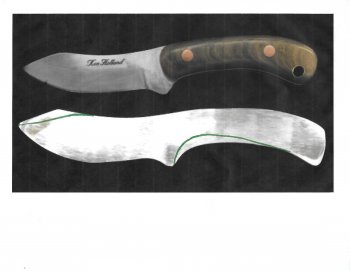
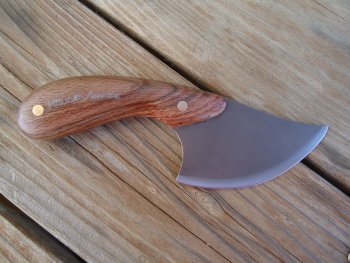
OK folks - I need some comments here. I made the knife below a while back, and thinking about making another. It's sorta of a knockoff of a old skinning knife blade shape.. well, it just sorta looked good. Getting ready to make another so cut a pattern out.... now I'm not sure. Is the belly too full on new pattern? The raised point on spine swedge have too much point? Is it too curvy? Honest comments ya'll. Yea, I know the tong hole is too close to the edge in the finished knife - that prevented me from flaring the tube which I prefer.

Skinner.jpg
 
For a skinning application, I personally like a bit more belly (such as the bottom one). Two things that I would prefer are a faster taper at the point (for skinning you want to be able to get in/around the eyes and ears when caping an animal, which means a the point should have a shallower angle from edge to spine..... almost a flat area of the edge just behind the point for 1/4-3/8"). I'd also like to see a sharpening choil notch centered at the plunge lines.... the way the top one is, there's about 1/2-1" of the edge that would be nearly impossible to sharpen in the field.

The handle shape appears good.....looks like it would fit a hand well. The only advice I might offer there is make the handle a bit wider (top to bottom) at the rear. The way I arrive at that is thinking about how the human hand closes around any object.....the smallest "grip" area is the area of thumb/index finger.....and the widest/largest area is the pinky/heel of the hand area. That's not a show stopper by any means if it's not done, as often times, in a skinning scenario, the user is "choked up" on the knife anyway.
 
Thanks for comments Ed - I hadn't thought about the need for a sharper point, more like the top point? Perhaps even a bit more... maybe increase the belly on bottom pattern so the point moves up to "just below" the line of the point at swedge?

I agree with you on the narrow handle - the top one is less wide than the bottom. The bottom is around 1" wide (top to bottom). The top has a fairly thick handle which helps with the narrow profile. I can take some of the curve out of top rear part of handle to give more thickness at rear. I was trying to keep more curve in top to sorta match the curve on bottom.

Part of the problem is "tight wad" me trying to make it fit a 1-1/2" wide billet so there's less waste than when using a 2" wide billet. If I had wide metal so I could layout several blades on each slab of metal that wouldn't be a problem. I'm VERY much a 1 off (sometimes two) knifemaker.

Thank you again for your helpful comments. I'll do some changing and post a revised pattern.
 
What Ed said...you did have a shallower angle at the front of the top one...when you added more belly that caused the angle to widen....I also like a severe stop at the ricasso area...a bloody hand can slip over about anything....here's a rough sketch of what i would do...

You can thin down the front of the handle a bit since you're skinning not fighting...lol.
kens skinner.jpg
 
Thanks Ted - you've pegged some of the things needed to do. I was already looking at a smaller wheel to grind the front of handle to provide more of a stop for the hand. Agree with you, I like swoopy in a skinning knife also. I just tried to edit photo a bit to show some, but didn't do go good. Got to take wife out to supper shortly. Back later.

Thanks to all for comments.
 
Yes swoopy is good for a skinner and I also agree with Ed On a point for certain areas.But I think pointy and swoopy on a knife may look weird :)
 
Thanks Rick - now rest of ya'll. FFG or with a bevel and grind line? Note the top blade isn't a FFG, and actually has a grind line that follows the curve of the belly. It's really hard to see in photo. I personally like a FFG, gives a better angle for sharp edge, I don't have to worry about getting the grind line right. BUT - it just seemed like a bevel and grind line would look good on first knife. What say ya'll - FFG? Or grind line?
 
For a skinning application, I personally like a bit more belly (such as the bottom one). Two things that I would prefer are a faster taper at the point (for skinning you want to be able to get in/around the eyes and ears when caping an animal, which means a the point should have a shallower angle from edge to spine..... almost a flat area of the edge just behind the point for 1/4-3/8"). I'd also like to see a sharpening choil notch centered at the plunge lines.... the way the top one is, there's about 1/2-1" of the edge that would be nearly impossible to sharpen in the field.

The handle shape appears good.....looks like it would fit a hand well. The only advice I might offer there is make the handle a bit wider (top to bottom) at the rear. The way I arrive at that is thinking about how the human hand closes around any object.....the smallest "grip" area is the area of thumb/index finger.....and the widest/largest area is the pinky/heel of the hand area. That's not a show stopper by any means if it's not done, as often times, in a skinning scenario, the user is "choked up" on the knife anyway.
What Ed says is what I have been saying about skinning knives, you have the belly and the sweeping edge correct, just needs to be pointier. also, as I have gigantic hands and for some reason they lack dexterity if you were to do a few light file grooves on that recasso area facing the handle to give the hand a little better purchase on the handle it would be right on the money and right up my alley!
 
Thanks Rick - now rest of ya'll. FFG or with a bevel and grind line? Note the top blade isn't a FFG, and actually has a grind line that follows the curve of the belly. It's really hard to see in photo. I personally like a FFG, gives a better angle for sharp edge, I don't have to worry about getting the grind line right. BUT - it just seemed like a bevel and grind line would look good on first knife. What say ya'll - FFG? Or grind line?
Hollow grind if you're like me and don't chop bones with your knives, or a bevel with grind line, nice and high
 
Hollow grind is an option - I'd have to work on that some. I've got 8", 10", & 12" contact wheels. Here's how I've mod'd at this point. I dropped the point on top of swedge to give a bit pointer end, but trying not to get too much point. I used a smaller wheel for the "guard" portion of the handle to prevent hand from sliding forward, and the same size smaller wheel for the curve in front of "guard". I'm thinking perhaps the grind line something like shown. Should I move grind line higher? I'd like to have room to etch name on flat above grind line, if it's not a FFG grind.

The notch Ed mentioned to add at ricasso for aid in sharpening. Hmmmm, not sure it'll work good, and when using in field just how much use will the very back of blade get anyway to require sharpening? That is a question, NOT a statement. I'm here to learn.

JJB, you mention light file grooves, you talking about on spine just forward of handle? If so, that would be easy to add and look good, and perhaps useful.

Skinner_2.jpg
 
Hollow grind is an option - I'd have to work on that some. I've got 8", 10", & 12" contact wheels. Here's how I've mod'd at this point. I dropped the point on top of swedge to give a bit pointer end, but trying not to get too much point. I used a smaller wheel for the "guard" portion of the handle to prevent hand from sliding forward, and the same size smaller wheel for the curve in front of "guard". I'm thinking perhaps the grind line something like shown. Should I move grind line higher? I'd like to have room to etch name on flat above grind line, if it's not a FFG grind.

The notch Ed mentioned to add at ricasso for aid in sharpening. Hmmmm, not sure it'll work good, and when using in field just how much use will the very back of blade get anyway to require sharpening? That is a question, NOT a statement. I'm here to learn.

JJB, you mention light file grooves, you talking about on spine just forward of handle? If so, that would be easy to add and look good, and perhaps useful.

Skinner_2.jpg
I was talking about just forward of the handle on the "Guard" you could also do some on the spine by the ricasso, I like to pinch my knife with two fingers when working around some of the tight spots, lets the knife slip into place for me, a little bit of extra grip there would be nice
 
There's a reason the Old Timer skinner is a classic - it's pretty much perfect for a white tail skinner, but then again it's not. When it comes to skinning, I am conflicted. For the actual caping (and trying to avoid sticking holes in the cape) I like a big, round, swoopy blade with almost no point. Basically a Nessmuk style blade.

Every time I try to design a skinner I end up with pretty much exactly the knife you are working on now- some hybrid of the two and my design just looks a tad goofy for some reason. And I think the the reason is exactly that- it's a knife trying to be two different knives at the same time.

I think this is why the Loveless drop point design has been such a tremendous hit. It may not be perfect but it's a darn good compromise between a trailing point skinner and a nessmuk.

The design you have now looks really good- I think if you can give it a sexier handle it will be fantastic, and maybe part of that "sexier" handle is to thin up that chunky guard. Maybe bring the curve of the handle up into that guard area so that the guard is more of hook than a triangle.
 
When I learn to make folders one of the first projects I want to do is a Damascus Case Trapper style pocket knife for my Dad
 
Part of the problem is "tight wad" me trying to make it fit a 1-1/2" wide billet so there's less waste than when using a 2" wide billet. If I had wide metal so I could layout several blades on each slab of metal that wouldn't be a problem. I'm VERY much a 1 off (sometimes two) knifemaker.

I have the same illness...I cure it by using a hybrid technic. When I am using stock removal and I want a curvy knife I profile it from the billet straight then I go to my forge and use hammer (sometimes wooden hammer) and anvil to add the curves. It only takes a little practice to draw a curvy knife straight then hot bend the curves. Just keep in mind it may look a little shorter when you curve everything so drawing the straight profile a little longer helps me. I always do karambits this way. You would be surprised what you can “fit” on a smaller billet using this method. If you do not have an anvil most bends could be done with the judicious use of a vise but make sure the vise will hold up to hot work, some just crumble...dont ask.
 
OK folks - I need some comments here. I made the knife below a while back, and thinking about making another. It's sorta of a knockoff of a old skinning knife blade shape.. well, it just sorta looked good. Getting ready to make another so cut a pattern out.... now I'm not sure. Is the belly too full on new pattern? The raised point on spine swedge have too much point? Is it too curvy? Honest comments ya'll. Yea, I know the tong hole is too close to the edge in the finished knife - that prevented me from flaring the tube which I prefer.

Skinner.jpg

Ken, far be for me to tell you how. So I will make a few suggestions. I would go with smaller pins and put the two pins and the lanyard it line. What ever that line might if its straight or an arch as what you are looking at in the top knife. Personally I have never used a lanyard. When the knife gets so slick you can't hang on you choke up on it!!

I saw a chiefs knife recently it had a stand made for it out some real pretty wood a nice package. The point I was about to make is the top of the copper guard was a circular indention! As soon as I saw it, I thought that is the choke-up point. A handle with that indention made in it would be a natural!!

You need a point to start the blade. However as John mentioned about the Old Timer too much point. And a very pointed knife will make it easy/peasy for cutting up an otherwise good skin!!

Once you get that blade started most of the movement is a flick of the wrist operation!! IMO anything hanging below the blade is in the way! There are times when you are in the body of skinning you will actually start that flick at the back of the blade and use it all the way to the tip! With that tip hanging down you have lost the use of the back end of the blade. To make the flicking motion, you are only going to be able to use the front tip of the blade!! If the blade was flat at the back portion then the blade is good for cutting meat up. However the blade is not flat so make use of the curve!!!

You got a lot of thoughts to work with Ken, I can't see where you take the design next. Good luck my friend!

EDIT:
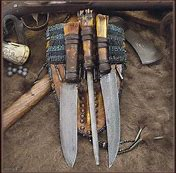
Ken, I thought of an easier way to explain this. This was a set Made by Chuck Burrows and this is a replica of an actual set used by the Buffalo Hunters, back in the day!!
1532982272837.pngThe trick to a successful skinner is the combining of both profiles into one. The curve of a skinner and the point of the starting knife!!
 
Last edited:
I just saw that you were asking about the grind, sorry. In my opinion the decision between FFG and grind lines is purely up to the individual preference. I do not do hollow grinds on my skinning knives because I tend to use them to rip violently through the Brest bone with my knife. Now a hollow grind may do fine with that but I like my tried and true flat grind, I have not used many hollow grind knives. I would consider a hollow grind if all I were going to do was field dress and take to a processor but we do all of our own butchering. Deer, sheep, chickens, pigs and so on.
 
Back
Top