Cherry Burl

DanF

Well-Known Member
IMG_20180803_133245.jpg
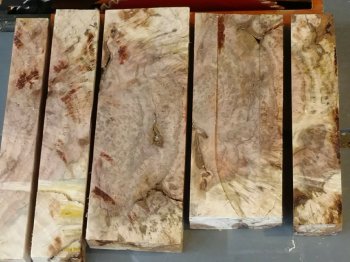
Early last winter, I cut a wild cherry tree on my place that had an eighteen inch diameter burl/bunyun/blister about three feet off the ground encompassing the trunk. This is from a small chunk of it I cut into last week. If my calculations are correct, it should yield enough good figure for around 40-50 knives.
 
Do you have to dry it or whatever? It’s purty I’d be interested also
Hey Kevin, yeah and it is a fairly long process. I'm at the point now where I'll be cutting the 50 lb+ quarters into 1-1/2" slabs and then sealing it to keep it from checking, twisting, warping and splitting.
I suspect someone else will be using a good bit of it sometime down the road.

I'll definitely keep you and Dennis in mind.
 
I am about to cut into a piece of oak burl. I hope it is as nice as the cherry burl. Perhaps we will arrange a trade? Keeping my fingers crossed for the wood fairy to be nice to me...
 
Sounds like a plan, I'll let you know when it gets closer to being ready to work down into knife-sized blanks.
As Forest would say, "cutting into a burl is like a box of chocolates". ;)
 
What is the process. I found someone near me that makes blanks for turning bowls. Is there a way to tell how dry it is? How dry should it be before stabilizing and using for scales?
 
Well, time is the majority of the process, time and taking steps to keep it from drying out too fast creating cracks, checks, and warps. You can paint it or dip it in wax (end grain) to keep it from losing too much moisture too fast. When I first cut it, the moisture content was around 28-29%, when it hit 18-20% I started cutting it into 1-1/2" thick pieces and then painted it again to keep it from drying out too fast. Once it hits around 8-12% MC I'll finish it into handle and scale sizes.
On large pieces, you can guage MC by weight (raw wood out of doors is around 29%, depending on your region). Once it looses nearly half its weight, cut it into the smaller chunks and then a wood moisture meter can be used. Most of my scales are 6-8% MC before I use them.
Anyone with more info, please feel free to chime in!
 
Any recommendations on a meter to check moisture content??

You can find them from $29 on up to hundreds of $$$. Like Mike noted, K&G is going to check them so you just need to be in the ballpark. I bought a $59 or $69 one from Woodcraft and it seems to do okay for this purpose. I imagine most have a few degrees plus or minus varience in accuracy. Once you get them at or under 8%, I've know a couple people who will put them in an oven around 150-165f to get them a little lower.
 
I have access to a part woodland which surrounds a crematorium, I thinkI can go onto it all but never certain, will check it out for unusual wood.

Is holly OK for scales?
 
Any recommendations on a meter to check moisture content??

This is the one I use. https://smile.amazon.com/gp/product/B0000224D4/ref=oh_aui_search_detailpage?ie=UTF8&psc=1
Delmhorst was considered top of the line when I was working at the sawmill and drying lumber. It's a little pricey, but I'm drying a batch of blocks every couple months.
A couple pointers on drying wood. If the wood is a fairly hard, dense wood, it will get checks (small cracks) when it is air drying. It's important to keep the wood in a dust free area during this time. If the checks fill with dust, they won't close up later in the drying process. It's important that wood isn't dried too fast as this can cause permanent cracks, checks and stress in the wood. You don't want to get the wood dry and split a block into scales and have them warp all over the place.
I can't keep fresh cut wood in my heated and air conditioned shop as it's too dry and the wood dries too fast. I usually bring wood into the shop after it has dried to 16-18% moisture. When it gets to 10-12%, I will put it in my dryer to dry. I start out at 90 degrees for a couple days then raise the temperature each day until I get to 115 - 120 degrees. It usually takes a week or more to get the wood blocks to 6-8%.

 
This is the one I use. https://smile.amazon.com/gp/product/B0000224D4/ref=oh_aui_search_detailpage?ie=UTF8&psc=1
Delmhorst was considered top of the line when I was working at the sawmill and drying lumber. It's a little pricey, but I'm drying a batch of blocks every couple months.
A couple pointers on drying wood. If the wood is a fairly hard, dense wood, it will get checks (small cracks) when it is air drying. It's important to keep the wood in a dust free area during this time. If the checks fill with dust, they won't close up later in the drying process. It's important that wood isn't dried too fast as this can cause permanent cracks, checks and stress in the wood. You don't want to get the wood dry and split a block into scales and have them warp all over the place.
I can't keep fresh cut wood in my heated and air conditioned shop as it's too dry and the wood dries too fast. I usually bring wood into the shop after it has dried to 16-18% moisture. When it gets to 10-12%, I will put it in my dryer to dry. I start out at 90 degrees for a couple days then raise the temperature each day until I get to 115 - 120 degrees. It usually takes a week or more to get the wood blocks to 6-8%.

Thanks for adding to my knowledge base, much appreciated!
 
IMG_20180809_154429.jpg
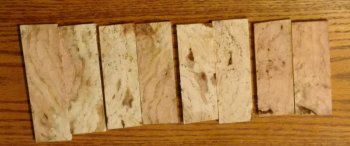
These four scales are from the outer portions of the burl, not part of the nicer looking ones I originally posted. They will do for my basic knives though
 
Back
Top